


Hits:
Impact Factor10.0
DOI number:10.1016/j.earscirev.2026.105518
Teaching and Research Group:石油教研室
Funded by:国家重点研发计划(2016YFC0401803);国家自然科学基金项目 (42241204);UQ MRFF grant (RM2016000555) ;中山大学博士研究生国外访问与合作研究项目
Key Words:Calcite geochronology;U-Pb dating;U-Th dating;Brittle deformation;Fault activity
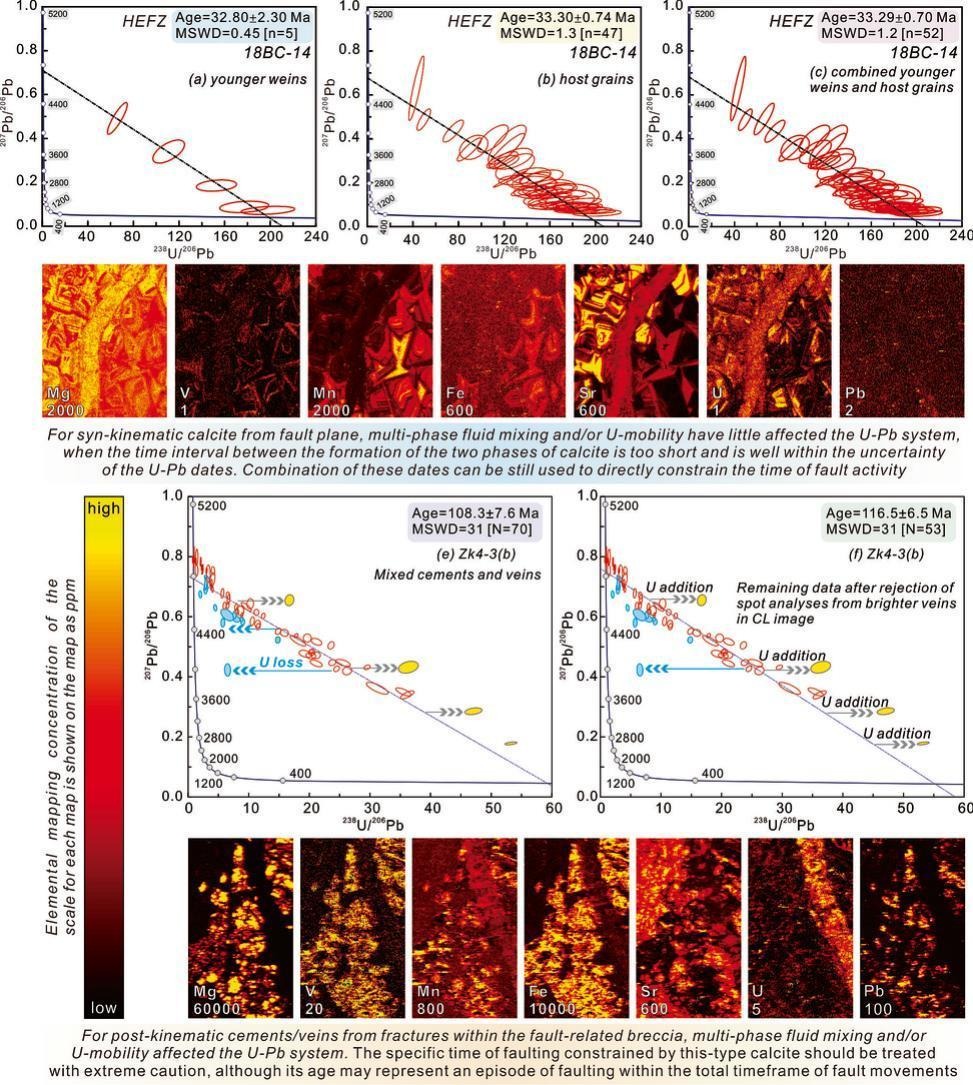
Abstract:Accurate dating of brittle fracturing and faulting is vital for a better understanding of continental deformation. The development of U-series and in situ U-Pb geochronology of carbonates opened new possibilities for tectonic and geodynamic reconstructions, since carbonate mineralization is common in many settings of brittle deformation. The SE Tibetan Plateau has experienced complex and multi-stages deformation histories and is still one of the most tectonically active and rapidly deforming regions of the continental crust. It represents an ideal natural laboratory for investigating intracontinental deformation processes in response to both Tethys Ocean closure and ongoing continental convergence-collision. This study provides fault-related calcite geochronological evidence to investigate the history of fault activity during brittle deformation in the SE Tibetan Plateau. Twenty-two fault-related carbonates from the Lijiang-Jianchuan, Heqing-Eryuan and Longpan-Qiaohou fault zones yielded U-series ages larger than 500 ka, which beyond its applicable timeframe ranges and their actual ages should be treated as >500 ka, with their older limits undefined. These samples then underwent LA-ICPMS in situ U-Pb dating. Nine samples, four of them containing multi-generational phases, yielded thirteen ages: 238.0 ± 6.1, 186 ± 34, 145 ± 25, 130.8 ± 9.0, 116.5 ± 6.5, 109 ± 45, 58 ± 11, 51 ± 22, 37.8 ± 8.7, 33.29 ± 0.70, 27.9 ± 2.2, 13.0 ± 5.8 and 8.2 ± 2.4 Ma, respectively. The earliest fault-related calcite precipitated at 238 Ma, which might be related to the subduction stage of the Paleo-Tethys and the subsequent Songpan Ganze-Yidun Arc-Qiangtang convergence-collision process. The fault-related calcite vein with a U-Pb age of 186 Ma formed in association with movements between the Indochina and South China blocks influenced by the subduction of the Meso-Tethys Ocean, and the coeval accretion of Meso-Tethys oceanic plateau along the Bangong-Nujiang suture. Subsequently, the subduction of the Meso-Tethys Ocean during Early Cretaceous might have activated these fault zones during 145–109 Ma, resulting in the formation of fault-related cements and veins. More frequent fault movements occurred during 58–51, 38–28, and 13–8 Ma, most likely in response to the Cenozoic India-Eurasia collision and opening of the South China Sea. Our work documents the history of fault activity from 238 Ma to 8 Ma in response to brittle deformation in the SE Tibetan Plateau, which is well correlated with regional tectonics. This study demonstrates the effectiveness of carbonate geochronology in reconstructing long-term history of fault activity during the brittle deformation.
Indexed by:Journal paper
Document Code:105518
Discipline:Natural Science
First-Level Discipline:Geology
Translation or Not:no
Included Journals:SCI
Links to published journals:https://doi.org/10.1016/j.earscirev.2026.105518
First Author:Yang Peng
All the Authors:Zhao Jian-xin
All the Authors:Uysal I. Tonguç
All the Authors:Huang Qiangtai
All the Authors:Cai Zhourong
All the Authors:Feng Yue-xing
All the Authors:Zhou Renjie
All the Authors:Xia Bin